




Westcliff Solitaire – Play Online for Free
Westcliff Solitaire comes from the Klondike family, yet it lays out its cards very differently from its famous relative. Instead of seven columns with long face-down piles, you are looking at ten short columns of three cards each, and only two cards in each are hidden. The appeal lies in that shortness: you see a great deal right from the start, but you have to get by with a single pass through the stock.
Westcliff has no colorful origin story the way some other games do; it is known mostly from English-language books and collections of card games. A look at the neighborhood is still worthwhile: Easthaven, a game with a similar-sounding name, opens almost the same way with three-card columns of two face-down cards and one face-up card, only with seven columns instead of ten, and its stock drops one card onto each column in turn. Westcliff is one of the more forgiving games of its kind, because an empty column here takes any card at all, and that can rescue many a tangled position.
Ten Short Columns, One Pass: Rules and Tactics for Westcliff
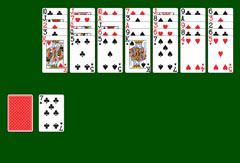
The deal gives each of the ten columns three cards, two face down and one face up on top. The other 22 cards wait in the stock, and there are four foundations, one for each suit. Once all 52 cards sit there in order from Ace to King, the game is yours.
- Building in the tableau: Downward and alternating between red and black, so a red Nine goes on a black Ten.
- Moving sequences: Any face-up card may travel onto a fitting base together with the cards lying on it, whether that means a whole sequence or only its upper part.
- Face-down cards: Whenever a face-down card suddenly lies on top, it flips over.
- Empty columns: Any card or sequence fits in here; you do not need a King to fill one.
- Stock: A click reveals a single card, and the topmost face-up card is always the one you can play. When the stock is empty, there is no second round.
- Foundations: One per suit, climbing rank by rank from Ace up to King. A card may also come back down from there into the tableau.
The level leaves the rules untouched: Easy deals the cards more kindly, Hard calls for more planning. With Undo and the Hint button you can always take a step back or pick up a fresh idea.
Ways to squeeze more out of every game:
- Face-down cards take priority: Twenty cards start out hidden. A move that turns one of them over almost always does more for you than one that merely reshuffles face-up cards.
- Respect the single pass: You see each card from the stock only once. Before every click, check whether the face-up card still fits somewhere, or it will end up under the next one and only come free again after you have played that card away.
- Build on tidy columns: Put sequences preferably where no face-down cards are left. Covering a column that still hides two cards only delays the moment you turn them over.
- Use a gap as a parking spot: Because an empty column takes any card, you can leave a card there that is currently blocking a face-down one, and move it onto a proper base later.
- Think ahead with Undo: When a tricky decision comes up, try out one line of play and jump back if it goes nowhere.
Other Tables, Similar Ideas: Five Solitaire Games to Try Next
The quirks of this game appear more than once on this site, just in a different mix each time:
- Solitaire: Seven columns, and the ones further right hold up to six face-down cards, far more than the two here. An empty column there waits for a King; only on Easy may any card move in.
- Harp Solitaire: There, too, new cards arrive from the stock one at a time, though from two decks and over several passes. Several cards only travel together when a King leads the way, and then solely into a free column.
- Forty Thieves Solitaire: Likewise ten columns, a single pass through the stock and gaps that take any card. On the other hand, every card lies face up, building stays within the same suit, and you always move just one card.
- Spider Solitaire: Spider knows ten columns and open gaps as well, but its stock lays out ten cards at a time, one per column, and only while no column is empty.
- Yukon Solitaire: No stock at all here, as the whole deck goes into the tableau at the start. Any face-up card may move along with everything on it, even when that pile is out of order, but a gap is reserved for a King.