




Simple Simon – Play Online for Free
Simple Simon is a solitaire game with nothing to hide: all 52 cards are on display from the very first moment, and no stock waits in reserve. Whoever wins owes it not to a lucky card turning up but to a good plan. That makes the game more of a brainteaser played with cards than a matter of chance.
The name most likely points to the Simple Simon of the old English nursery rhyme, a rather gullible lad who meets a pieman on his way to the fair. Only the first steps are simple, though, because the rules fit into a few sentences while tidying up the table takes a clear head. With Spider it shares the goal of lining up every suit as a closed run from the King downward, which then leaves the table by itself. Yet it gets by with a single deck and no face-down cards at all, which is why card game collections usually place it in the Spider family.
Simple Simon: Rules, Group Moves and Clever Tricks
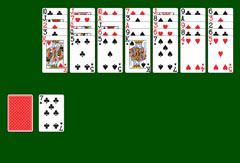
The 52 cards are spread across ten columns. The three on the left get eight cards each, and from there every column gets one card fewer, until a lone card remains on the far right. Your goal is to arrange each of the four suits in one gapless run, King at the top and Ace at the bottom. As soon as such a run lies together in one column, it moves on its own to one of the four spaces at the top right, and once all four have arrived there, the game is won.
- Building: Any card may take the next lower one, whatever its suit. A Six therefore fits on every Seven.
- Moving groups: You can shift several cards at once only when they form an unbroken run in one suit, for instance the Nine, Eight and Seven of Spades. Mixed runs are allowed, but you have to take them apart again piece by piece.
- Empty columns: Any card may move in, and so may any group of one suit. For a King it is the only possible place anyway, as no rank stands above it.
- Finished runs: A suit from King to Ace leaves automatically. You never put a card on those spaces by hand.
- Tap or drag: Tapping a card moves the whole same-suit run it belongs to. To split a run, drag the card you want with the mouse or your finger.
The rules are identical on every level: Easy deals layouts that are easier to read, Hard asks for more detours. Undo and the Hint button help out when you have painted yourself into a corner.
These tricks will take you further:
- Reunite the suits: Placing a card on the card one rank higher in its own suit is nearly always progress, since only such runs can later travel as a unit.
- Go easy on mixed runs: Placing a card on a different suit gives you a moment of breathing room, but it ties that card down until you break the run up again.
- Guard empty columns like treasure: A free column lets you dismantle mixed runs, park Kings and reassemble suits. Fill it only when doing so clearly moves you forward.
- Start on the right: The columns on the right hold only a handful of cards. Clear them early and your first gaps appear quickly.
- Look before you move: Because everything is face up, it pays to check before your first move where the Kings are sitting and which suit will be the easiest to put together.
For Fans of Open-Card Planning: Five More Puzzles at the Card Table
Each of these five games picks up a piece of this one and adds an accent of its own:
- Spider Solitaire: The big brother with two decks. There, too, finished suit runs leave the table, but many cards begin face down, and a stock keeps dealing ten fresh cards. You choose how many suits take part yourself: one, two or four.
- Spiderette: Spider in a smaller format, with one deck and seven columns laid out as in Klondike. Just like here, only groups of one suit move together, but face-down cards and reinforcements from the stock join the mix.
- Scorpion Solitaire: Here as well, each suit is assembled from its King down to the Ace, but cards may only be placed within their own suit. In return, you can shift any face-up card together with everything stacked on it, even out of order, while a gap takes only a King.
- Freecell: Every card is likewise visible from the first deal, so luck in turning cards plays no part. You build red on black and black on red, and four free cells act as a temporary shelf.
- Eight Off: Also manages without face-down cards, builds sequences in the same suit and offers no fewer than eight free cells, four of which are taken at the start. Here, though, the cards travel one by one to foundations, starting with the Ace.