




Canfield Solitaire – Play Online for Free
Canfield Solitaire takes its name from Richard A. Canfield, who ran a well-known gambling house in Saratoga Springs, New York, around 1900. As the story goes, he turned the game into a wager: guests bought a deck for 50 dollars and got 5 dollars back for every card that ended up on a foundation. So you only came out ahead by placing at least eleven cards, and very few players ever did.
In Britain the very same game is called Demon, a name that fits its reputation well, while the name Canfield, confusingly, refers there to the game Americans know as Klondike. Thirteen cards sit in the reserve at the start, and only the top one can be seen. On top of that comes a quirk that sets Canfield apart from nearly every other solitaire: the foundations do not begin with the Ace but with the rank of a card that is turned up on the deal. Which rank that is changes with every game. In this online version the stock can be recycled as often as you like, just as the common rules allow.
Reserve, Base Card and Draw Three: Rules and Tricks for Canfield
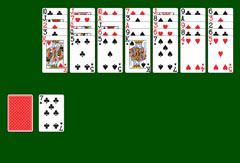
The game uses a standard 52-card deck. On the deal, 13 cards go to the reserve at the bottom left. One card goes straight onto one of the four foundations and becomes the base card: if it is a Seven, say, every foundation starts with the Seven of its suit. To the right of the reserve, each of the four tableau columns receives one face-up card, and the other 34 cards wait in the upper left corner as the stock. You win as soon as all 52 cards are on the foundations.
- Foundations: Each foundation is built upward in its suit, and after the King it carries on with the Ace. With a Seven as the base card, the order therefore runs Seven through King, then Ace through Six. A card may also return from a foundation to the tableau.
- Tableau: In the columns you build downward, alternating red and black cards. Here, too, the count wraps around the corner, so a King may go on an Ace. You can move ordered sequences as a whole or in part.
- Reserve: Its top card can be played at any time, to a foundation, to the tableau or to an empty column. The next card then flips over on its own. The reserve is never refilled.
- Empty columns: As long as the reserve still holds cards, only its top card may go into an empty column. Once it is used up, a gap accepts any card.
- Stock: One click lays three cards face up beside it, and the uppermost of them is playable. Once the stock is exhausted, you turn it over and deal through it again, as often as you want.
Easy, Normal and Hard follow the same rules; only the deals grow more stubborn from level to level. You can take back every move, and the Hint button suggests a sensible next step.
These tricks will help you bring more games home:
- The reserve comes first: Cards from the stock come around again on every pass, whereas the reserve gives up its cards one at a time. Every chance to get rid of its top card is worth its weight in gold, because the reserve decides the game.
- Keep gaps for the reserve: Since an empty column takes only the top reserve card for the time being, it pays to clear a column at exactly the moment that card has no other home.
- See through the draw of three: Because three cards are always turned at once, only every third card comes to the top on the next pass. Take a card off the face-up pile and this grouping shifts, suddenly bringing other cards within reach.
- Do not play every card up at once: A card sent to a foundation is no longer available in the tableau to hold the next card down in the other color. Send it up only when it is no longer needed there, and fetch it back if you have to.
- Dig out the other cards of the base rank: They open the remaining three foundations. As long as one of them is stuck in the reserve or buried under other cards, a whole foundation stays closed.
Five Related Solitaire Games for Your Next Round
Individual building blocks of this game turn up in other solitaire games on this site as well, each with a twist of its own:
- Solitaire: The best-known relative, also called Klondike, likewise builds in alternating red and black and offers the draw of three as an option. Instead of a reserve, face-down cards wait in seven columns, and the foundations always begin with the Ace.
- Freecell: The entire deck lies face up from the very beginning, and there is no stock at all. Four free cells serve as temporary storage, and because nothing is hidden, classic Freecell is considered solvable almost every time.
- Yukon Solitaire: If you like shifting whole sequences around, you get even more freedom here. Any face-up card may move to another column together with everything lying on it, even if the pile on top of it is in no particular order.
- Forty Thieves Solitaire: At least as unforgiving, just with different settings: two decks, ten columns, building only within the same suit and just one trip through the stock. You never move more than one card.
- Crescent Solitaire: Counting around the corner comes back here. On Normal and Hard, Ace and King count as neighbors in the 16 piles that curve around the foundations.