




Heart to Heart – Play Online for Free
Heart to Heart is a playful take on Pyramid Solitaire with two special features that jump out at once. The cards are not laid out as a pyramid but in the shape of a heart. And the deck consists of hearts alone: every rank from Ace to King is there four times over, 52 cards once again. Since the suit is the same everywhere, only the rank counts when you clear cards away.
Nothing suggests that the game comes from old books of card games; it is known mostly from online collections that list it as a variant of Pyramid. The family resemblance is obvious, but so are the differences. In Pyramid, two cards have to add up to 13 and a King leaves on its own, whereas here any two cards of equal rank belong together, two Kings included. And while a pyramid is taken apart from the bottom up, the heart is emptied from the top down toward its point.
Pairs in the Heart: Rules and Tricks for Heart to Heart
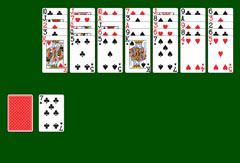
Twenty-five cards form the heart, spread across seven rows. The top row has a notch in the middle between the two curves, and below it each row gets one card narrower until a lone card forms the point at the very bottom. The other 27 cards sit in a stock at the bottom left, with the waste pile beside it, and the pairs you clear collect at the bottom right. You have won the moment the heart holds no more cards; whatever is still in the stock does not matter.
- Free cards: The four cards of the top row are free from the start. Every other card becomes free once the cards of the row above that overlap it have disappeared.
- Making pairs: Two free cards of the same rank vanish together, two Sevens, say, or two Queens. A card on its own can never be cleared.
- The waste pile: Its top card counts as free and can pair up with any free card in the heart. Two cards taken only from the waste pile, however, will not work.
- Endless supply: Every click on the face-down stock brings a new card to light. Once it is empty, the next click gathers all the cards back, and you may do that as often as you want, on every level.
- Controls: Tap a free card and it gets a golden frame, then tap its partner. If the ranks do not match, the second card wiggles for a moment. You can also drag a card straight onto its partner. The top bar shows the pairs cleared so far, the cards left in the stock and how many times you have started it over.
The three levels share a single set of rules and differ in how kindly the ranks are spread through the heart.
Things to keep an eye on:
- Pair the heart's own cards first: A card from the waste pile will come around again on the next pass anyway. A card in the heart, by contrast, stands in the way of others. When two cards in the layout can form a pair, that is usually the better move.
- Watch for doubles stacked on each other: When two equal ranks lie so that one card covers the other, they can never be paired together. Each of them then needs another partner, and you should not spend that partner elsewhere too quickly.
- Counting pays off: Each rank appears just four times. Before pairing a card from the layout with the waste pile, check whether the remaining copies of that rank in the heart can still find each other afterward.
- Make use of the notch: Right beneath the gap in the top row lie two cards that each have only a single card above them. That makes the middle a fast route into the depths of the heart.
- No need to rush the stock: Since you can go through the stock as many times as you like, nothing is ever lost there. Just keep clicking until the right partner turns up.
From Pyramid to Trick-Taking: Five Games with Heart and Brains
Whether through pairs, free cards or simply the suit of hearts, each of these games links up at a different point:
- Pyramid Solitaire: The model for this game. There, too, a structure of 28 face-up cards is dismantled in pairs, but the two cards must add up to 13, and a King is allowed to leave on its own.
- Mahjong: The same principle with tiles instead of cards. A tile can only be used when nothing lies on it and one of its sides is open, and two identical tiles always leave the board together.
- Tri Peaks Solitaire: Instead of a heart, three peaks rise up there, and their cards also come free little by little. There are no pairs; every card you play has to be a neighbor in rank of the card showing on the discard pile.
- Memory: Pairs once more, only the cards are face down, and you have to remember where each one was. A pair consists of two completely identical cards.
- Hearts: Here hearts are no friends of yours but penalty points. In this trick-taking game for four, everyone tries to take in as few hearts as they can and, above all, to steer clear of the Queen of Spades.