




Easthaven – Play Online for Free
Easthaven is a single-deck solitaire game that crosses two great classics. You build the way you do in Klondike, downward in alternating colors, and only a King can reopen an empty column. New cards, on the other hand, arrive Spider style: one click on the stock puts a fresh face-up card on every column at the same time. Out of this blend comes a rhythm of its own, in which clearing up and dealing more cards keep taking turns.
You can look the game up in the work of Albert Morehead and Geoffrey Mott-Smith, among others, two American authors whose collection of solitaire games from the middle of the 20th century is still a standard reference. No source reveals where the name comes from; it sounds like a small harbor town on some eastern shore. Fittingly, Easthaven has a namesake from the west on this site that begins in much the same way. And there is a little arithmetic hidden in it, too: the 31 cards in the stock do not divide evenly among seven columns, so the final round only serves the first three.
Dealing in Step: Rules and Strategy for Easthaven
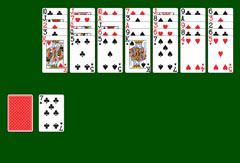
On the deal, each of the seven columns receives three cards, the lower two face down and the top one face up. The remaining 31 cards make up the face-down stock at the top left, while four empty foundations wait at the top right. You have won when every suit lies there complete from Ace to King.
- Building: Always one rank lower and in the other color, so the Eight of Hearts fits on the Nine of Clubs or the Nine of Spades.
- Moving several cards: A group relocates as one only when it is already in proper order, meaning descending and alternating in color.
- Face-down cards: When one of them ends up on top of its column, the game turns it over automatically.
- Empty columns: The only things allowed in are a King or an ordered sequence headed by a King.
- Dealing: A click on the stock puts one face-up card on each column from left to right. This only works while no column is empty; otherwise the game highlights the gaps instead of dealing. Four times you get seven cards, and the fifth and final time just three. There is no second pass, and the display in the top bar tells you how many rounds are left.
- Foundations: Cards go up by hand. Tapping a card sends it to its foundation if it fits there, or else to the best spot in the tableau, and of course you can drag cards as well. When the stock has run dry and no card is hidden anymore, the game clears away the rest by itself.
The rules stay the same on every level, but Easy more often deals games that can be solved, while on Hard more deals refuse to come out. Undo and Redo know no limit, and the Hint button lights up a sensible next move.
Keep these points in mind and you will win more often:
- Clean up before every click: Each new round lands on all seven columns, with no regard for suit or rank. Whatever you have not played up or moved beforehand is buried afterward. So play out everything useful first, and only then reach for the stock.
- Empty a column only with a King to back you up: While a gap is open, the stock gives you nothing, and only a King can fill that gap. Clearing a column without a King in reach may cut off your own supply.
- Free the face-down cards early: At the start only fourteen cards are hidden, but every round from the stock lays another layer over them. The sooner you turn them over, the less you will have to dig through later.
- Do not rush cards to the foundations: Whatever sits on a foundation stays there in this game. Aces and Twos belong up there right away, but a middle card may still be missed as a base when the next round brings a fitting lower card.
- Keep the last round in mind: It reaches only the first three columns. Sequences you build to the right of them will not get another card on top after that.
From the Same Family Tree: Five Solitaire Games for Later
This game has two parents, a namesake and a few distant relatives, and you can meet all of them here as well:
- Solitaire: Building in alternating colors comes from here. The columns there grow from one to seven cards, and the stock does not go into the columns but, card by card or three at a time, onto a waste pile that you may leaf through as often as you like.
- Spider Solitaire: The other parent, which gave Easthaven its stock that supplies every column at once, although Spider deals ten cards per round from two decks. The suit plays no part when you build there, and a suit is cleared only once it lies together in full from King to Ace.
- Westcliff Solitaire: The namesake from the west also starts with piles of three cards, each showing just its top card face up, but spreads them over ten columns. Its stock is turned up one card at a time and only once, and in return a free column will take any card whatsoever.
- Spiderette: The cross from the opposite direction, namely Spider rules on a Klondike table. Its stock works almost exactly like the one here, with seven cards per round, a remainder of three for the first three columns and a lock while any column stands empty.
- Scorpion Solitaire: Nearly every card is already in the tableau when the game begins; only three hold back and land on the first three columns with a click, much like the last round in Easthaven. Building happens in the same suit, though, and any face-up card takes everything on top of it along when it moves. Empty columns are kept for Kings there, too.