




Gaps Solitaire – Play Online for Free
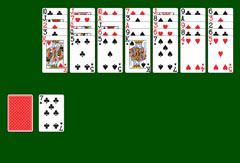
At first glance, Gaps Solitaire hardly looks like a solitaire game at all. The whole deck is dealt face up in four rows of thirteen, then the four Aces leave the table and leave four holes behind, the gaps that give the game its name. From there on, cards move one at a time into those holes until each row shows a single suit in unbroken order from the Two to the King. There is no stock and not one face-down card, so everything hinges on the order in which you fill the gaps.
The game is known by many names. Besides Gaps, Montana is the most common, and close cousins circulate as Spaces, Addiction or Blue Moon. How old the family is shows in a variant called House of Commons, which gets by with a shortened deck and was already described in English books of patience games in 1905 and 1911. Where rule collections disagree most is how often you may reshuffle. Three rounds are usual, which means two reshuffles, while some versions allow more or even no limit at all.
Gap by Gap to the Goal: How to Put Gaps Solitaire in Order
What you are aiming for is a board of four clean rows. Each row starts with a Two at its left end, followed to the right by the Three, the Four and so on in the same suit up to the King, and the row's gap is left over at its right end. Which suit ends up in which row is your decision.
- What fits in a gap: Exactly one card, namely the next higher card in the suit of the card to its left. A gap beside the Seven of Clubs therefore waits for the Eight of Clubs and nothing else.
- The left edge: A gap in the first column takes any Two, even one that currently heads another row.
- Dead gaps: When a King stands to the left of a gap, the gap can no longer take anything, since no rank comes after the King. The same goes for a gap directly to the right of another gap, until the left one has been filled.
- Every move passes the gap along: Wherever a card is taken away, the next gap opens at once, and it now waits for the card that follows its left neighbor.
- Reshuffling: When no move is left, the button below the grid becomes active. Every row keeps the cards that already lie correctly from its Two onward, and the rest is shuffled and dealt out again. Each row then receives exactly one gap, directly behind its ordered start or, if it has none, at the far left. That is allowed twice per game, and the number on the button shows how many reshuffles remain.
- Controls: A tap on a card makes it jump into the gap where it belongs. Tap a gap instead, and it pulls in the matching card. Only the Twos on the left edge often have several options; the game then marks them and a second tap decides. If you prefer dragging, simply move the card across yourself.
The same rules apply on all three levels, the two reshuffles included. Easy deals layouts that are kinder to small mistakes, Hard ones in which every gap counts from early on. An autopilot for the last few cards is left out on purpose, because right up to the end every move decides where the next gap will open.
Tricks for a tidy board:
- Leave cards next to Kings alone: Move away a card that lies to the right of a King and you create a dead gap. As long as other moves exist, do not waste one of your four gaps that way.
- Hand out the Twos thoughtfully: Each Two decides which suit a row will get. Favor the Two whose Three and Four can be brought over quickly.
- Think in chains: Every card you move tears open a new hole that calls for one particular card. Before you move, ask whether the next gap will be able to take something useful or will lead nowhere.
- Secure the left side before reshuffling: A reshuffle leaves in place only what is in unbroken order from the Two onward. Extend these starts as far as you can before pressing the button, since everything else gets dealt out anew.
- Ordered starts are safe: A row that opens with a Two on the left and continues without a break in the same suit stays put through every reshuffle, and none of its cards ever has to move again. Every card you add there is progress that lasts.
Everything in View, Everything to Plan: Five More Games for Puzzlers
These games also reward a good overview and foresight, some with cards and others without any:
- Freecell: As in Gaps, the whole deck is visible from the first moment, so there is no luck in turning cards over. The deck is split among eight columns, four free cells hold single cards in between, and you build downward in alternating colors.
- Simple Simon: Also free of face-down cards and without a stock, but played across ten columns. Here you sort every suit from the King downward, and once a run is complete, it clears itself away.
- Pyramid Solitaire: A pyramid of 28 face-up cards is taken apart in pairs, and each pair has to add up to 13. If you enjoy planning which card will come free when, you will feel at home there in no time.
- Memory: Here, too, the cards lie in a grid, but face down. You turn over two at a time and look for pairs of identical cards, meaning the same rank and the same suit.
- Sudoku: Not a card game, but the same satisfaction of getting everything into its proper place. The digits 1 to 9 each have to find their spot in every row, every column and every 3 by 3 box.