




Scopa – Play Online for Free
Scopa is Italian for broom, and the game lives up to the name: sweeping the whole table clean with a single card from your hand earns a point. In turn, everyone plays one card and uses it to capture table cards of the same value or a group whose values add up to it. When a round is over, the teams count who has taken the most cards, the most coins, the most valuable Seven and the best primiera. Together with Briscola and Tressette, Scopa is one of the three great card games of Italy. Here you team up with the computer player sitting opposite you and take on the other two.
By the 18th century the game was already known all over Italy and was especially popular in Naples. Older evidence is missing; it probably descends from two Spanish games, Primero and Scarabucion, and the name of the primiera scoring still recalls the first of them. Italian emigrants took Scopa to Argentina and Brazil, where it is mostly played as Scopa a Quindici, and it is also played in Libya, Somalia and Tunisia. English speakers know a close cousin in Casino, often spelled Cassino, the only game of this capturing kind that ever caught on in the English-speaking world; its supposed Italian origin, however, has never been proven.
The Italian deck has 40 cards in the suits coppe, denari, spade and bastoni, meaning cups, coins, swords and batons. The Seven of Coins is called the settebello and is the most coveted card of all, because it counts in all four categories scored after each round. Whoever makes a scopa traditionally places one card face up and crosswise in their pile, so it is not forgotten when the points are tallied. And the four-player version, Scopone, has even earned a place in World Cup history: on the flight home after Italy won the title in 1982, President Sandro Pertini played a game with coach Enzo Bearzot, goalkeeper Dino Zoff and Franco Causio, with the trophy standing right there on the table.
Capture, Count, Sweep: The Rules of Scopa
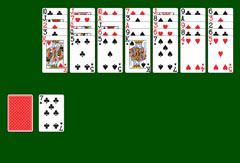
Here the game is played with French-suited cards from which the Eights, Nines and Tens have been removed, leaving 40 cards. Diamonds take the role of the coins, so the settebello is the Seven of Diamonds. For capturing, the Ace counts 1, the Two through Seven their face value, the Jack 8, the Queen 9 and the King 10.
- The deal: Everyone gets three cards, and four lie face up in the middle. When all hands have been played out, three new cards follow, three times per round in all, but fresh table cards only at the start. If three cards of the same value show up on the table then, the deck is reshuffled. You lead in every round, and play then continues clockwise.
- Same value: If a card of your value lies on the table, you must take exactly that card. If there are several, you pick one of them, but you may never take them all together.
- Sum: Only when no card of the same value is on the table may you collect several cards that together add up to the value of your card. A King, for example, takes a Three and a Seven.
- Discarding: If nothing fits at all, your card stays face up on the table.
- Choosing: When there are several possibilities, your card waits at the bottom left, the eligible table cards are outlined, and you tap the ones you want. As soon as your selection forms an allowed group, the cards are captured.
- Scopa: Clear the table completely and your team scores a point on the spot. Only the very last move of a round does not count as a scopa.
- End of the round: Any cards still on the table after the last move go to the team that captured last. Then one point each goes to the most cards, the most diamonds and the settebello. On a tie, nobody gets that point.
- Primiera: Each team counts only its best card in each suit: the Seven as 21, the Six as 18, the Ace as 16, then down from the Five as 15 to the Two as 12, and face cards as 10. The higher total earns one more point.
- Victory: The team with 11 points or more after a round wins. If both teams get there, the higher score decides, and on a tie play goes on.
Each team carries a card symbol as its name, and the displays at the sides show the scores. The difficulty level applies only to the two opponents, and your partner always plays the same way. On Easy their choices are largely random; on Hard they also make sure not to leave you a table you could sweep.
Tips for a better tally when the round is scored:
- Guard the settebello: The Seven of Diamonds scores a point by itself, counts toward cards and diamonds, and is the strongest card for the primiera. Never put it on the table if you can help it.
- Collect Sevens and Sixes: For the primiera, only the best card of each suit counts. A Seven in every suit is almost unbeatable, while face cards hardly help there at all.
- Leave more than ten behind: No card is worth more than 10. If the table cards add up to more than ten after your move, nobody can clear them in one go. A single card, on the other hand, gets picked up by anyone holding its value.
- Think about your left-hand neighbor: After you, the opponent on your left takes a turn. Whatever you leave behind, that player sees first.
- Keep count: There are exactly four cards of each value. If three Queens have already been played and the fourth lies on the table, nobody can take it with a Queen anymore, only by way of a sum.
- Plan the last capture: In the third deal of a round, it pays to be the last to capture. Everything still on the table then belongs to your team, and that can tip the balance for cards and diamonds.
Add Up, Collect, Stick Together: Five More Games
If you like adding up values, playing as a team or counting your haul once all the cards are played, your next game is waiting here:
- Pyramid Solitaire: There, too, face cards turn into numbers, only with different values: the Jack counts 11, the Queen 12 and the King 13. Cards go in pairs, and every pair that adds up to 13 leaves the board until the pyramid is gone.
- Calculation Solitaire: Mental arithmetic without opponents. Four piles grow here at fixed intervals, the first by one and the last by four, until each of them ends with a King.
- Spades: Once again your partner sits across from you, and once again only what the two of you win together counts. Instead of capturing cards from the table, you take tricks, and spades are always trump.
- Hearts: Here, too, each player's haul is counted after every round, except that you want as little of it as possible. Every heart costs a point, and the Queen of Spades thirteen at once.
- Durak: What Scopa is to Italy, Durak is to Russia, the card game almost everyone there knows. Its deck is shortened as well, to 36 cards from the Six up, and instead of a winner, the game ends with one loser.