




Harp Solitaire – Play Online for Free
Harp Solitaire belongs to the big family that grew up around Klondike, the game named after the Yukon gold rush of the late 1890s. Harp doubles the material: two full decks, 104 cards in all, are dealt into nine columns, with eight foundations waiting above them. Even if you can play Klondike in your sleep, you will soon find that Harp is more than just a bigger Klondike.
The rule books do not fully agree on this game. A very close relative called Gargantua lets you move whole sequences of cards, some versions allow only single cards, and depending on the source the stock may be dealt through three or four times. This version takes a middle road: single cards move freely, while a whole sequence may only move when a King leads it into an empty column. And the name? With a little imagination, the nine columns of different lengths look like the strings of a harp.
Nine Columns, Eight Foundations and a King That Opens Doors: How to Play Harp Solitaire
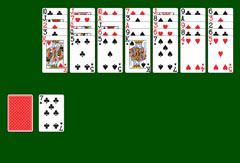
On the deal, the leftmost column receives a single card and each column after it one more, up to nine in the last. In every column just the uppermost card is face up; everything beneath it is face down. The remaining 59 cards form the stock, and its first card is turned over right at the start. Your goal is to move all 104 cards to the eight foundations, two for each suit.
- Foundations: Every foundation opens with an Ace and grows in its suit up to the King. You are allowed to move a foundation's top card back down into the tableau.
- Single cards: A face-up card takes the card one rank below it in the opposite color, such as a red Six on a black Seven. This works for the top card of every column and for the face-up card next to the stock alike.
- Sequences: A group of cards may move together only when the sequence starts with a King, and only into an empty column. Onto an occupied column, exactly one card moves at a time.
- Empty columns: A gap accepts nothing but a King, either alone or together with the sequence resting on it.
- Face-down cards: Whenever a column's uppermost card is uncovered, it turns over by itself.
- Stock: Every click turns over exactly one card. On Normal and Hard you go through the stock three times, on Easy as often as you like.
On Easy, games come out noticeably more often, while Hard serves up the trickiest deals. The top bar keeps a running count of the passes you have left, and Undo and Hint are ready whenever you need them.
What really makes the difference in this game:
- Kings are the key: Only a King may fill a gap, and only with a King at its head can you move several cards together. A King sitting in the middle of a column still has face-down cards under it. Shift it into a free column and a new card comes to light at once.
- Clear a column only for a King: An empty column is worth something only while a King is ready to move in. Without one, it just sits there doing nothing.
- Put the doubled cards to work: Two decks mean more choice. A black Six can land on each of the four red Sevens in play. That lets you rebuild a long sequence card by card onto another fitting base until the face-down card beneath it is free.
- Read the stock on the first pass: Since every card is turned over on its own, each pass shows you the whole stock. Note where the Aces and Kings are hiding the first time through, before you start one of the few passes that remain.
- Treat the foundations as a lending library: If a card has nowhere to go, bring the card it needs down from its foundation into the tableau. It will climb back up later.
From Klondike to Spider: Five Solitaire Games Built on Similar Plans
Harp combines building blocks that each get their own starring role in other games on this site:
- Solitaire: The original, with a single deck and seven columns. Here you may move ordered sequences freely between columns, and the stock gives you one card or three, depending on whether you choose Draw 1 or Draw 3.
- Double Solitaire: The closest relative on this site, also played with two decks, nine columns and eight foundations. The difference lies in how freely cards move, because in Double Solitaire whole sequences may travel onto occupied columns as well.
- Forty Thieves Solitaire: Shares the single-card moves and the eight foundations with Harp. There, though, the whole deal is face up in ten columns from the start, you build only within a suit, and the stock goes through just once.
- Canfield Solitaire: Another descendant of Klondike with alternating colors in the tableau, but with just one deck, four columns and a reserve of 13 cards that you work down bit by bit.
- Spider Solitaire: Here, too, 104 cards are waiting. Instead of sending them to foundations, you build complete runs of one suit, King down to Ace, across ten columns, and each finished run leaves the table.