




Australian Solitaire – Play Online for Free
Australian Solitaire, listed in most card books as Australian Patience, is assembled from two well-known games. The layout and the freedom to move whole packets of cards come from Yukon, the stock and the foundations from Klondike. It adds one ingredient of its own: you do not build in alternating colors but strictly within the same suit. Every card in the tableau is face up from the start, so only the stock holds any surprises.
There is no documented origin story, and apart from its name nothing suggests that the game really comes from the other side of the world. What is worth knowing instead is a peculiarity that follows straight from the rules. Because every card appears only once in the game, each card in the tableau has at most one place where it fits, namely on the next rank up within its own suit. Where a card belongs is therefore clear at a glance; getting it there often is not, because when that one spot lies buried under other cards, only reshuffling the tableau will help. Even though you can see almost everything, this makes the game one of the trickier single-deck solitaires.
Suit on Suit, Packet on Packet: Rules and Tricks for Australian Solitaire
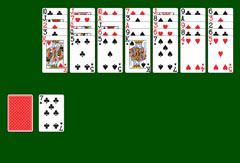
The game is played with 52 cards. Seven columns of four cards each are dealt face up, and the remaining 24 are stacked up as the stock in the top left corner. The game turns the first of them over right away onto the waste pile next to it. Four foundations take shape at the top right, and victory comes once all four suits are stacked there without a gap, each with its King on top.
- Building: Down by exactly one rank and only in the same suit. The Ten of Diamonds therefore accepts nothing but the Nine of Diamonds.
- Moving packets: You may move any card together with everything piled on it, even when the cards above it lie in total disorder. Only the bottom card of the packet has to fit.
- Empty columns: Only a King may go in there, and it may bring along whatever lies on it.
- Stock: Each click adds exactly one new card to the waste pile; you can only play the card lying on top. On Normal and Hard the stock runs through just once; on Easy you may go through it a second time.
- Foundations: Only the top card of a column or of the waste pile ever moves there, climbing suit by suit.
- Controls: When you tap a card, it goes to the foundation of its suit if it can, and otherwise to the one place in the tableau that suits it. If there is no such place, the column gives a little shake. When you drag with the mouse or your finger, everything lying on the card you pick up travels with it. Once the stock is empty and the rest can be played off without obstacles, the game makes the final moves for you.
Unlike many solitaire games on this site, the level really does change a rule here, since only Easy grants you the second pass through the stock. On top of that, the cards fall most kindly on Easy and least kindly on Hard. On every level, empty columns take Kings and nothing else. You can undo or redo moves as often as you like, and the Hint button shows you where to go next.
What counts in this game:
- Prefer small packets: Grab a card from deep down and you haul everything above it along, burying it in the target column. When several moves are on offer, the one with the lightest load is usually the better choice.
- Spot knots early: If a higher card lies somewhere above a lower card of the same suit, such as the Seven of Spades above the Four of Spades, the lower one only comes free after the upper one has gone, yet the upper one may only go to its foundation after the lower one. So the upper card has to move within the tableau, alone or as part of a packet. Look out for such spots early on, and for the place that can take that card.
- Save gaps for the right King: A free column is only useful when a King is ready whose move uncovers an important card. Decide in advance which King that should be.
- Prepare landing spots for the stock: Every card from the stock also has exactly one possible spot in the tableau, on the card one rank above it in its suit. If that place is open when the card appears, it is saved. So before you click on, clear as many column ends as you can that will serve as a base.
Two Ancestors, Three Cousins: Where to Head Next
If you want to know where the individual rules come from, or would like to try one of them in a different setting, here is the right table for you:
- Solitaire: The ancestor that supplied the stock and the waste pile. Most tableau cards lie face down there, you build in alternating colors, and the stock may start over as often as you like, with one or three cards per click.
- Yukon Solitaire: The second ancestor, from which this game inherited moving whole packets. There is no stock there, since all cards go straight into the tableau, many of them face down at first, and colors have to alternate when you build.
- Scorpion Solitaire: The closest relative in terms of rules, with building in the same suit, packets that move with their whole load and gaps for Kings only. Instead of a stock, Scorpion holds back just three cards, and the four left-hand columns start with three face-down cards each.
- Forty Thieves Solitaire: Also four face-up cards per column, building in the same suit and a stock without a second pass, though with two decks spread over ten columns. You only ever move a single card there, but a free column accepts any card.
- Eight Off: Here, too, the whole tableau is in view and the suit governs every build. Instead of a stock there are eight free cells, four of them occupied from the start, and longer sequences only move when enough cells are free to park cards along the way.