


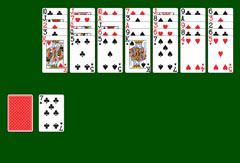


Mau-Mau – Play Online for Free
Mau-Mau is one of the best-known card games in the German-speaking world, and many families there teach it to their children early on. The idea could hardly be simpler: whoever gets rid of all their cards first wins. You play whatever matches the top card in suit or rank, and a handful of special cards make sure that no round plays out like the one before. Here you take on three computer opponents, so you need neither fellow players nor a deck of cards.
Familiar as the game is, surprisingly little is known about its origins. No clear first mention has turned up, and nobody knows for sure where the name comes from. Word of mouth has it that the rules already existed in the 1930s, but Mau-Mau only appears in print after the Second World War: the first rule descriptions came out in the late 1950s, and even in the early 1960s it counted as a brand-new game. Today it is as popular in Germany, Austria and South Tyrol as it is in Brazil. English speakers will recognize its relatives, Crazy Eights in America and Switch in Britain and Ireland, and the commercial game Uno is built on the same basic idea.
Suit, Rank and Three Special Cards: How a Game of Mau-Mau Goes
The game uses 32 cards from the Seven up to the Ace in the four suits of clubs, spades, hearts and diamonds. All four players are dealt five cards, one more is turned face up as the starting card, and the rest forms the face-down stock. You go first, and play then passes around the table.
- Playing a card: You may play a card if it matches the top card in suit or in rank. On the Ten of Hearts, any heart and any Ten will do, and you always play exactly one card per turn.
- The Seven: The next player has to draw two cards, unless they play a Seven of their own. In that case the player after them must draw four, after three Sevens six, and so on. Whoever takes the penalty also loses their turn.
- The Eight: The next player has to sit out a turn.
- The Jack: It goes on any card except another Jack. Whoever plays it names the suit that must be played next.
- Drawing: If you cannot play, you draw a card from the stock. If it fits, you may play it right away; if not, the next player is up. As long as you hold a card that fits, the stock stays closed to you, and in that case you even have to play a Seven.
- Mau and Mau-Mau: The game calls out "Mau!" for you as you play your second-to-last card, so you can never forget it. Whoever plays their final card wins the round on the spot, even with a special card.
The starting card is never a Seven, an Eight or a Jack, so nobody gets punished before the first move. The Ace has no special power here, unlike at some kitchen tables where it lets you play again. On Easy the opponents play more carelessly and you usually start with a better hand; on Hard they hold back Sevens and Eights until the player after them is on the verge of winning, and your opening hand often turns out weaker.
Tips for more wins:
- Save your Jacks: A Jack fits nearly every time and spares you from drawing. So play it only when nothing else works, or when naming a suit can decide the game.
- Call the right suit: Name the suit you hold the most cards in yourself. That way you can keep playing over the next few turns.
- Sevens make a shield: A Seven of your own is the only answer to an opponent's Seven. Spend yours too early and you may later have to swallow a whole chain of penalty cards.
- Count your opponents' cards: The table shows how many cards everyone is still holding. If the player after you is down to one or two, that is the moment for an Eight or a Seven, because both hit exactly that player.
- Keep your hand varied: With cards in all four suits you will find a match more easily. Prefer shedding cards from suits you hold several of, and keep lone cards as wild cards for a change of suit.
Up for Another Round? Five Games for Game Night on Your Screen
If shedding cards and outwitting opponents has given you a taste for more, here are further classics against the computer:
- Uno: The most famous descendant of the same idea. Cards match in color or number, and action cards of its own such as Reverse or Wild Draw Four come on top.
- Hearts: A trick-taking game for four in which you want to collect as few hearts as possible and never the Queen of Spades. In three rounds out of four, you first pass three cards to another player.
- Spades: The team player among trick-taking games. Before each round, you and your partner bid how many tricks you will take, and spades beat every other suit.
- Backgammon: Among the oldest board games anywhere, a contest where luck with the dice meets clever choices. You race your fifteen checkers home against the computer and hit lone enemy checkers along the way.
- Durak: Another game with a short deck, except that what counts is not who finishes first but who is left holding cards. You attack, you beat off attacks with higher cards or trumps, and the loser ends up with the title of fool.