




All in a Row – Play Online for Free
In All in a Row, the entire deck travels onto a single pile, card by card and always one rank higher or lower. There are no fresh cards to draw and no surprises beneath the surface, because all 52 cards can be seen from the deal onward. Luck therefore only plays a part in the deal itself; after that, everything depends on the sequence in which you clear the cards. The game belongs to the Golf family but goes one step further: here there is no border between King and Ace.
The story behind the name takes a surprising turn. It comes from Henry Preble's 1909 book A Month of Solitaires, in which he presented 31 solitaire games of his own devising, and it reappears in an American collection in 1931. According to research by solitaire historians, however, Preble's original was played differently, with groups of at least two consecutive cards being removed together. The version that is common today, one unbroken chain of single cards, probably goes back to a misreading modeled on the game Black Hole. The games writer David Parlett even proposed a separate name for this variant for that reason: Quasar.
A Chain Without End: How to Play All in a Row
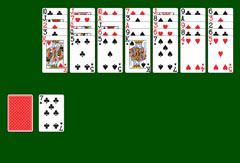
The 52 cards lie face up in thirteen columns of four. Since that many columns do not fit side by side, seven of them stand at the top and six at the bottom, and in the middle of the lower half sits the spot for the row on which every card is meant to end up. You have won when not a single column holds a card anymore.
- Playable cards: In each column only the front card is free, the one no other card overlaps. The cards behind it only get their turn after it has gone.
- The first move: The row starts out empty, and you may open it with any free card you like.
- Building on: From then on, only a card that directly follows the top card of the row will fit, meaning one rank above or below it. The suit does not matter.
- Around the corner: King and Ace count as neighbors. A King may therefore take a Queen or an Ace, and an Ace a King or a Two.
- No way back: Whatever lies on the row stays there, and no new cards are added. When no free card fits anymore, the game is over.
- Controls: Tapping a free card puts it on the row if it fits; if not, the card shakes. You can drag cards onto the row as well. The counter at the top tells you how many cards are still waiting on the table.
The rules do not change from level to level. On Easy the deal forgives the odd detour, while Hard hides far more moves that quietly turn a game unsolvable.
How to keep your chain going longer:
- Pick your opening card with care: The first card decides which directions are open to you. Before you start, look at the ranks at the ends of the columns and begin where a long sequence is taking shape.
- Every rank needs neighbors: An Eight can only follow a Seven or a Nine. Once every Seven and Nine is on the row, any Eight still out there stays stranded for good. So keep track of how many copies of each rank are still missing.
- Turn around before it gets tight: You may switch from going up to going down at any moment. That is precisely what makes long chains possible, such as Five, Six, Five, Four.
- Remember the deep columns: A column with important ranks at the back has to be worked down in time. If you only ever take the most convenient cards, you end up facing columns whose front card fits nowhere.
- Compare routes with Undo: Since everything is out in the open, you can test two continuations and keep the better one. A single choice between two equally fitting cards often decides between winning and losing.
One Rank Up, One Rank Down: Five Games for Chain Builders
If you like thinking in sequences, or enjoy games where only a card's rank counts, you will find more challenges here:
- Golf Solitaire: The direct relative. There, too, one card after another moves onto a pile, but a supply of face-down cards helps out when nothing fits. In exchange, the ladder stops at King and Ace, and jumping from one to the other is forbidden.
- Tri Peaks Solitaire: Three mountains of cards instead of thirteen columns, again with a supply held in reserve. Tri Peaks allows the step from King to Ace only on its easiest level, whereas here it always applies.
- Accordion Solitaire: The whole deck lies face up there as well, but as a long snake that squeezes itself together move by move until, ideally, a single pile remains.
- Calculation Solitaire: Here, too, you count past the King to the Ace, on four foundations at once and in steps of one to four. The cards come from a stock, though, and wait on discard piles until they are needed.
- Heart to Heart: Another game in which the suit plays no part. From a heart of 25 cards you clear pairs of the same rank, and you may run through the stock as often as you please.