




Canasta – Play Online for Free
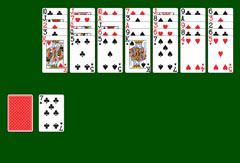
Canasta belongs to the large rummy family, and its name is Spanish for basket. It comes from Uruguay: according to tradition it was devised around 1939 at the Jockey Club in Montevideo by the lawyer Segundo Santos and the architect Alberto Serrato. The rules were refined further in Argentina, and in 1949 the game reached New York. In the early 1950s it was such a craze in America that for a while it threatened to push bridge aside. Many North American players now prefer a version of their own, Modern American Canasta, and Hand and Foot is a relative too; this game sticks to the classic rules. Join a computer partner against a pair of computer opponents and play canasta online, free and with no sign-up.
Seven of a kind: Canasta rules, points and tips
You play in two fixed teams, with your partner in the seat opposite. In play are 108 cards, two full decks with four jokers between them, and everyone gets eleven. Jokers and twos are wild cards and stand in for almost any rank. What a team melds belongs to both partners, and you score your points together.
- Draw and discard: On your turn you either draw from the stock or take the whole discard pile, then meld as much as you like and discard one card. The first round is yours to open, and after that the next player in turn starts.
- Melds: A meld consists of at least three cards of the same rank, with at least two natural cards and no more than three wild ones. Sequences in a suit do not exist here, and a team has only one meld per rank, which both partners add to.
- The initial meld: A team's first meld must reach a minimum count that rises with the score: 50 below 1500 points, 90 up to 2999, 120 from 3000 on, and only 15 when the score is below zero. For this the card values count: joker 50, two and ace 20, king to eight 10, seven to four and the black three 5.
- Canasta: Seven cards of one rank make a canasta. Without a wild card it is natural and scores 500 points; with wild cards it is mixed and scores 300.
- The discard pile: You may take it only if you meld its top card right away. Usually a natural pair of that rank, a natural card plus a wild one, or a meld of your own that the card fits is enough. The pile is frozen as long as your team has not melded yet or a card lies crosswise in it, as every discarded wild card does. Then you need two natural cards of that rank. If a wild card or a black three is on top, nobody may take it.
- Red and black threes: You put a red three face up at once and draw a replacement. It is worth 100 points, all four together 800, but only if your team has melded something in that round; otherwise they are deducted. Black threes may go on the table only when going out.
- Going out: Your team may go out only once it has at least one canasta; until then you have to keep a card after discarding. Going out earns 100 points. If you put down your whole hand in a single turn, with a canasta of your own and without having melded before, you go out concealed and get 200.
- Scoring: At the end of the round the melded cards count for the team and the cards still in hand against it. Once the stock is empty, you must take the discard pile if its top card fits one of your melds; otherwise the round ends. The team that reaches the target score first wins, and if both get there in the same round, the higher score wins.
Instead of a difficulty level you choose the target score here: 1500, 3000 or 5000. The higher it is, the longer the match lasts. Your partner plays solidly, the two opponents a little weaker. To take the discard pile, first select the matching cards from your hand; the pile then lights up, and a click takes it. Before your first meld the Lay Down button counts how many points your selection is worth. The question "May I go out?" to your partner, which some groups ask, is not part of this version.
This is how your team brings home more points:
- Work toward a canasta early: Without one your team cannot go out, and every card still in your hand at the end costs points.
- Freeze the pile: If the discard pile grows large and the opponents are collecting a rank, discard a wild card. After that they need a natural pair to take it.
- Black threes as a brake: A black three as your discard blocks the pile for the next opponent, just when they want it.
- Don't feed the opponents' melds: If your discard fits one of their melds, they can take the pile with it as long as it is not frozen.
- Use wild cards wisely: A natural canasta scores 200 points more than a mixed one. A joker still in your hand at the end of the round, on the other hand, costs 50.
Meld, take tricks, capture: five games for the next round
If you want to keep playing after going out, these games are a good match:
- Rummy: The big relative with a stock and a discard pile. Besides sets of the same rank you also lay out runs in one suit here, and everyone plays for themselves.
- Bridge: Fixed partnerships again, with your partner opposite. Instead of melds there is an auction and 13 tricks, and whoever wins the contract also plays their partner's cards.
- Scopa: Here too two teams collect cards. In Scopa you capture table cards whose value or sum matches the card you play.
- Doppelkopf: Also played with a doubled deck, every card twice, but as a trick-taking game, where the queens of clubs give away who plays together.
- Mau-Mau: You already know drawing and discarding. Here you play suit on suit or rank on rank and want to be the first without cards.