




Calculation Solitaire – Play Online for Free
Calculation Solitaire is a game in which mental arithmetic gets a seat at the table. Four foundations start with an Ace, a Two, a Three and a Four and grow in steps of one, two, three and four until every one of them is crowned by a King. The suits of the cards play no part whatsoever; only the rank counts. Chance decides the order in which cards come out of the stock. What matters is where you keep them until their turn comes.
The game also goes by the names Broken Intervals, Hopscotch and Four Kings. Who invented it and where it comes from cannot be said with any certainty; it is one of the old solitaire games handed down over generations. A close relative called Musical even does without the four holding piles and works with a single discard pile. There is a little mathematics behind the four sequences: because 13 is a prime number, every step size from one to four hits each of the thirteen ranks exactly once and finishes on the King. Each foundation therefore needs exactly one card of every rank, and between them the four use up the deck down to the very last card.
Four Sequences, Four Waste Piles, One Stock: How Calculation Solitaire Works
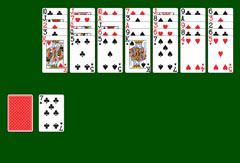
At the start, the game sets out an Ace, a Two, a Three and a Four as the base cards of the foundations, in any suits. The remaining 48 cards form the stock, beside which one card always lies face up and ready. On the left you find the stock and the face-up card with the four foundations beneath them, and on the right four waste piles that begin empty. The four sequences are:
- Ace foundation, counting by ones: A, 2, 3, 4, 5, 6, 7, 8, 9, 10, J, Q, K
- Two foundation, counting by twos: 2, 4, 6, 8, 10, Q, A, 3, 5, 7, 9, J, K
- Three foundation, counting by threes: 3, 6, 9, Q, 2, 5, 8, J, A, 4, 7, 10, K
- Four foundation, counting by fours: 4, 8, Q, 3, 7, J, 2, 6, 10, A, 5, 9, K
Here A, J, Q and K stand for Ace, Jack, Queen and King. Past the King, each sequence carries on at the Ace, which is why the Ace follows the Queen on the Two foundation. So that you do not have to keep count yourself, every foundation displays the rank it needs next, using those same letters.
- The face-up card: It has to find a home, either on a foundation that calls for exactly its rank or on one of the four waste piles, where any card fits. Once it has been placed, the next one appears without another click.
- Waste piles: Only the top card may leave a waste pile, and only for a foundation. Nothing is shifted between the waste piles.
- A single pass: When the stock is used up, there is no second round. The game is lost if at that point no top card of a waste pile fits anywhere.
- Controls: Tap the face-up card and, if a foundation wants it, it lands there; if several do, it goes to the one that is furthest behind. If it fits nowhere, the four waste piles light up and a second tap picks the one you want. Dragging works too, of course. Once it is clear that everything else will go smoothly, the game carries the remaining cards up on its own.
The rules apply equally on all three levels. Easy leaves more room for cards that were set down in awkward places, whereas on Hard nearly every decision has to be right.
Tried-and-tested thinking for the four waste piles:
- One pile for the Kings: Every sequence ends with a King, so Kings are needed only at the very end. Many players therefore reserve one waste pile for Kings alone, so that they never cover a card that is due sooner.
- Tell early from late: An old rule of thumb suggests placing Sixes, Eights and Queens early and Tens, Jacks and Kings late. If you know which ranks will be wanted soon, put the others underneath.
- Stack in reverse order: The best card to lay on a waste pile is one that will be needed before the card beneath it. That way the pile can later be played off in order from the top down.
- Like on like: If a waste pile already shows a card of the same rank on top, it is the ideal spot. The same rank stays visible, and no other card gets covered.
Count, Reckon, Combine: Five Tables for Friends of Numbers
In these games, too, ranks and numbers matter more than suits:
- Pyramid Solitaire: There is arithmetic here as well, just of another kind. Two face-up cards that add up to 13 disappear together, and a King goes by itself. The suit makes no difference there either, and step by step a pyramid of 28 cards comes down.
- Canfield Solitaire: There, too, the foundations need not begin with the Ace. A random base card sets the starting rank, and the sequences run past the King to the Ace. You build within the suit, though, and in the tableau red and black alternate.
- Golf Solitaire: Only the rank counts, never the suit. A card fits on the discard pile if the two ranks differ by exactly one, and instead of planning sequences in advance, you read long chains off seven columns.
- Tri Peaks Solitaire: The same principle as Golf, spread over three peaks of face-up cards. On Easy, King and Ace even count as neighbors there, much as the number sequences here run on past the King.
- Sudoku: No cards at all, but plenty of number logic. A grid of 9 by 9 squares is filled with the digits 1 to 9 so that no digit repeats within a row, a column or a block of 3 by 3 squares.