




Baker's Dozen – Play Online for Free
Baker's Dozen is a solitaire game in which everything lies face up on the table from the outset. The 52 cards are spread over thirteen columns of four, and no stock ever sends reinforcements. If you want to win, you have to think ahead, because every card moves on its own, and a column that has been emptied stays unused for the rest of the game. The rules take a minute to explain; the games take a good deal longer to crack.
The game is an old one: the American publisher William Brisbane Dick first printed it in 1883 under the title The Baker's Dozen, and its rules have barely changed since. The name counts the columns, since a baker's dozen means thirteen. Where the phrase itself comes from is explained in more than one way. A popular story says that medieval English bakers threw in an extra loaf to escape the harsh penalties for selling bread that was too light. The Oxford English Dictionary points instead to a trade custom: whoever sold a dozen to a shopkeeper added a thirteenth loaf as the shopkeeper's profit. Related games such as Spanish Patience or Portuguese Solitaire differ mainly in what an empty column is allowed to take.
Thirteen Columns, No Reinforcements: The Rules of Baker's Dozen and How to Use Them
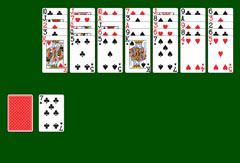
On the deal, four face-up cards land in each of the thirteen columns. Should a King end up covering other cards of its column, it slips beneath them to the start of the column, where it no longer covers anything. Seven columns sit in the upper row and six in the lower one, and along the right edge the four foundations wait one above the other, each suit climbing there from its Ace.
- Free cards: Only the card at the end of a column, with nothing lying on it, can be moved, and only one at a time.
- Moving: A card may go on the end of another column when it is exactly one rank lower than the card there, whatever its suit. A Seven therefore fits on any of the four Eights.
- Empty columns: Once a column is empty, it stays empty. No card may enter, not even a King, and that holds on every level.
- Foundations: Each suit grows there rank by rank until its King crowns the pile. Only on Easy may you bring the top card of a foundation back into the tableau; on Normal and Hard a card that has gone up stays up.
- Controls: Tapping puts a card on its foundation whenever it fits, and otherwise onto a column that will accept it. If neither is possible, it gives a little wiggle. Dragging works as well, and as soon as it is certain that the rest will come out, the game plays the last cards by itself.
Apart from the take-back on Easy, all three levels follow the same rules. Easy deals layouts that forgive a mistake more readily, while on Hard the important cards are buried deeper.
Proven tricks for the thirteen columns:
- Empty a column only when it pays off: An empty column is of no more use to you. So remove the last card of a column only when it can go straight to its foundation, rather than merely shoving it onto another column.
- Free the Aces and Twos first: The foundations can only grow once their low cards are free. At the start, look specifically for columns in which an Ace lies under just a few cards.
- Choose the destination with care: A card often has several places it could go. Put it where it does not cover a card you will soon need, ideally on a column whose end will have to wait a long while anyway.
- Think of Kings as bedrock: Because every King lies beneath all the other cards of its column, it never blocks anything. Once a column is worked down to its King, it is perfect for descending sequences, since nothing below it is needed any sooner.
- Long sequences cost moves later: Every card of a sequence has to come off again individually. Build only as far as you can foresee getting those cards onto the foundations.
Everything Face Up, One Card per Move: Five Kindred Spirits
These games share the open layout, the single-card moves or both, but each one puts the emphasis somewhere else:
- All in a Row: The same layout of thirteen columns of four, even split into two rows in the same way. Instead of going to foundations, though, the cards travel onto a single row there, each one step up or down from the one before.
- Simple Simon: Here, too, the suit does not matter when you build, and everything is out in the open. In exchange, runs of one suit may move together, and any card may go into a free column, exactly what Baker's Dozen forbids.
- Freecell: The best-known solitaire with an open layout. Single cards can be parked in four free cells, and you build alternating red and black.
- Eight Off: Eight columns of face-up cards and no fewer than eight cells for temporary storage, half of them occupied at the start. Building there sticks strictly to the same suit.
- Forty & Eight Solitaire: You also move just one card at a time, though with two decks, a stock and empty columns that accept any card.