




Doppelkopf – Play Online for Free
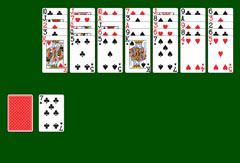
Doppelkopf is a card game for four that grew out of the old German game of Schafkopf played with a doubled deck, and the name points to it: Schafkopf means sheep's head, Doppelkopf double head. As early as 1811 Paul Hammer described several forms of Schafkopf with two decks in Leipzig. Today the game is at home above all in northern and western Germany, and nearly every group keeps its own house rules, which is why the German Doppelkopf Association, founded in Brunswick on March 27, 1982, works toward a single set of rules. Some cards have nicknames: the ten of hearts is the Dulle, the ace of diamonds the fox, and the two queens of clubs are known as the old ones. The 48 cards are exactly those of an American pinochle deck. Play Doppelkopf online here at no cost and with no account needed, against three computer players who are sometimes on your side and sometimes against you.
Two club queens, two parties: Doppelkopf rules, announcements and tips
Four players share 48 cards: each of the four suits runs from the nine to the ace, and every card is in the deck twice. Everyone is dealt twelve. An ace is worth 11 card points, a ten 10, a king, queen and jack 4, 3 and 2, and the nines nothing at all, which adds up to 240. The two players holding a queen of clubs form the Re party, the other two the Kontra party. Nobody says at the start who belongs with whom; that only comes out in the course of play.
- Trumps: In a normal game 26 cards are trumps. At the very top stands the ten of hearts, the Dulle. It is followed by the four queens and then the four jacks, clubs before spades before hearts before diamonds in both groups, and last of all the ace, ten, king and nine of diamonds. Clubs, spades and hearts are plain suits, and hearts has only six cards without its two tens. If two identical cards land in the same trick, the one played first wins, and that goes for the Dulle too.
- Leading and following: The first trick is opened by the player on the dealer's left; after that, each trick is led by whoever won the one before. You must follow suit, playing the same suit to a plain suit and a trump to a trump. Only if you cannot do so may you trump or throw off any card.
- Healthy or reservation: Before the first card is played, each player in turn says "Healthy" or announces a reservation. Through "Solo" you pick one of seven solos and then play alone against the other three. In a Queen Solo only the queens are trumps, in a Jack Solo only the jacks; in a Clubs, Spades or Hearts Solo the chosen suit takes the place of diamonds; the Diamonds Solo keeps the trumps of a normal game; and the Ace Solo, the meatless solo in German, has no trumps at all. A solo counts triple for the soloist.
- Marriage: If you hold both queens of clubs, you can announce a marriage. Your partner is whoever first wins one of the first three tricks. If you take all three yourself, you play on alone, and the deal is scored like a solo. With "Silent Solo" you give nothing away and play alone against three from the start, again scored triple.
- Re, Kontra and further announcements: You may announce Re or Kontra as long as you still have at least eleven cards in your hand. After that your party can declare, step by step, what the opponents will no longer reach: No 90, No 60, No 30 and Schwarz. Each further step gives you one card more time. The button to the right of your place in the trick always shows the announcement that is possible right now.
- Winning: Without announcements, Re needs 121 card points, while 120 are enough for Kontra. Every announcement of your own raises the target: after No 90 your party needs 151 card points, after No 60 181, after No 30 211 and after Schwarz every trick. If only the opponents have announced No 90, as few as 90 card points will do for your party.
- Points: The winners get one point for the game and one more each if the losers stay below 90, 60 or 30 card points or take no trick. Every Re or Kontra brings the winners two points, every further announcement one. In each deal that does not count as a solo there are extra points: for a Doppelkopf, a trick worth at least 40 card points; for catching a fox, the opposing party's ace of diamonds; for Charlie, when a jack of clubs wins the last trick; and for Kontra winning against the club queens.
A match runs for eight deals, and the deal moves one seat to the left each time. After that the top score wins, and if several share the lead, play goes on. The game follows the tournament rules of the German Doppelkopf Association, played with nines. There is no compulsory solo, and no poverty, piglets or bock rounds either. On Easy your three opponents play every card at random and never announce anything; on Hard they work out the end of each deal trick by trick.
These tactics will put your party ahead:
- Read the parties: Whoever plays a queen of clubs is Re. Whoever drops a plain card on a trump lead has no trumps left, and so no queen of clubs either, and belongs to Kontra. Whatever the table learns this way appears on that player's name tag.
- Show your colors with an announcement: An early Re or Kontra tells your partner where you sit and earns two points if you win. With a weak hand you hand those same two points to the opponents.
- Protect the fox: Your ace of diamonds is a trump, but a weak one. Play it only into a trick your party is sure to win, or the opponents collect an extra point.
- Rich tricks for your partner: When you know a trick is going to your partner, add a ten or an ace. It may turn into a Doppelkopf, and you get past the card points you need sooner.
- Save Charlie for last: If no higher trump can be expected for the last trick, hold on to a jack of clubs until the end. If it wins the last trick, you earn an extra point.
When the club queens take a break: five more games for the card table
For anyone who would like something else on the table between two matches:
- Skat: The other great German trick-taking classic gets by with three players and 32 cards. The bidding decides who plays alone against the other two, and the highest trumps there are the four jacks, not the queens.
- Spades: Two against two again, except that your partner sits across from you for good. Before each round everyone estimates how many tricks they will take, and spades trump every other suit.
- Hearts: Four players and tricks just like here, but everyone plays alone and wants as few of them as possible. Penalty points come from hearts and from the queen of spades, and before most rounds three of your cards go to another player.
- Rummy: Here too every card is in the deck twice, plus two jokers, 106 cards in all. Instead of taking tricks you lay out runs and sets and aim to shed every card before the others do.
- Scopa: Two pairs play against each other, and this time everyone knows from the first move who is on their side. A card from your hand takes table cards that match it in value or add up to it, and sweeping the table earns you a scopa.