




Forty & Eight Solitaire – Play Online for Free
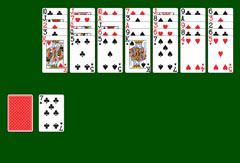
Forty & Eight Solitaire belongs to the large Forty Thieves family and, like the rest of that clan, is played with two decks. It does two things differently: the forty face-up starting cards lie in eight columns of five instead of ten columns of four, and the stock may be turned over once. Both changes work in the player's favor. The games still demand patience, however, because only a single card ever moves at a time.
Who invented the game and how long it has been played is not documented. There is no reliable explanation for the name either; the most obvious reading is that it simply describes the layout, forty cards on the table and eight foundations. To American ears, though, the words have another ring. French freight cars stenciled "Hommes 40, Chevaux 8", meaning room for 40 men or 8 horses, carried American soldiers to the front in World War I, and in 1920 veterans of that war founded an honor society named after them. Whether the solitaire game is meant to recall any of this has not been recorded. The rule books, by the way, disagree about the stock: some allow no second pass at all, while here you get exactly one.
Getting Forty & Eight Solitaire Right: Eight Columns, One Card per Move, Two Passes
Out of 104 cards, forty are dealt face up into eight columns, five apiece. The remaining 64 wait face down in the upper left corner, right beside the spot for the waste pile. Eight foundations line up alongside, two per suit, and the game is won when every one of them is complete from the Ace up to its King.
- Building: A card accepts only the next lower card of its own suit, so the Seven of Diamonds goes on an Eight of Diamonds. As every card appears twice, there are often two addresses to choose from.
- Single moves: You may only pick up the exposed card at the foot of a column, and it moves alone. Even a perfectly ordered run has to be relocated card by card.
- Empty columns: Any card at all may go into a free column.
- Stock: Each click sends one card to the waste pile, whose top card is playable. When the stock is empty, one more click turns the waste pile over once, and you go through the cards again in the same order. After that it is over, and a counter in the top bar shows whether you have already used your second round.
- Foundations: Cards travel there singly, either from the foot of a column or off the waste pile.
- Controls: Tap the exposed card of a column and it lands on its foundation if possible. Otherwise the game looks for the matching card in the tableau, preferring the column with the longer run of its suit, and resorts to an empty column only as a last option. Cards further up the column move neither by tapping nor by dragging. Once all the stock cards have been drawn and the rest is certain to come out, the game plays off the remaining cards by itself.
Every level plays by the same rules, and the second round through the stock is yours on each of them. Easy deals the cards more generously, while Hard puts more obstacles in your path.
What gets you furthest here:
- Build only what will soon go home: Every card you lay on a column must come off again later, one at a time. So prefer building in suits that are already well advanced on the foundations, so the cards can move straight up there before long.
- Use free columns as transfer points: A run can only be relocated by way of temporary spaces, and those exist only in empty columns. With two free columns, a run of three cards can already travel piece by piece to its new home.
- Prepare the second pass: When you turn the waste pile over, the cards come back in exactly the order you drew them. If you note during the first pass when an important card shows up, you can work toward it deliberately in the second.
- Dig out buried Aces: In columns of five cards, an Ace can be stuck under four others. Clearing such columns early usually pays off more than any building elsewhere.
Forty Thieves and Their Relatives: Five More Solitaire Games
Three of the following games come from the same family, and two share single ingredients such as the eight columns or the repeated pass:
- Forty Thieves Solitaire: The parent game, with ten columns of four cards each and no second trip through the stock. Single moves and the suit rule are the same, which makes it the much stricter sister.
- Josephine Solitaire: Another offshoot of Forty Thieves, but with a generous exception, as ordered runs in a single suit travel as one there. The deal is the same as in the parent game, and the stock runs through just once.
- Westcliff Solitaire: Counted as an offshoot of the same parent game, yet content with 52 cards. On ten short columns, two face-down cards sit under a face-up one, building alternates between red and black, and there, too, you get only one pass.
- Eight Off: Eight columns, suit-by-suit building and every card face up, but with just one deck and no stock. To make up for it, there are eight cells for single cards, half of them already occupied at the start, and on Normal and Hard an empty column takes nothing but a King.
- Harp Solitaire: Again two decks, eight foundations and more than one pass through the stock, three of them on Normal and Hard. The game is built like Klondike, though, with nine columns in which many cards start face down, and building in alternating colors.