




Accordion Solitaire – Play Online for Free
Accordion Solitaire needs nothing more than one long row. Every card of the deck stands face up side by side, and your goal is to push them together, move by move, into a single pile. As you do, the row contracts like the bellows of the instrument that lends the game its name. The rules fit into one sentence; the art lies in picking the right move when several are possible.
The game was first known as The Idle Year, and it has also been known as Tower of Babel, Methuselah and Leapfrog. Its rules already appear in game books from 1883 and 1905, whereas the name Accordion only shows up in the 1950s. In the old days the cards were dealt one at a time, and a new card was only added when no move was possible. You never knew what was coming next, and a win was a genuine rarity. Today all the cards usually lie in view from the start, as they do here, and a game of luck turns into a puzzle. A curious detail on the side: since every move makes exactly one pile disappear, every game that is won takes exactly 51 moves.
How Accordion Solitaire Works: One or Three Places Back, Suit or Rank
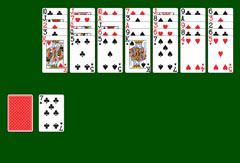
On the deal, all 52 cards land face up in a single row, each one a pile of its own to begin with. So that the row fits on the screen, it snakes across the table in five lines: the first runs from left to right, the second back again and so on, turning around at each end. You have won as soon as every card lies in a single pile.
- Moves: A pile may go onto the pile directly in front of it or onto the pile three places further forward when the two top cards match in suit or rank. The Nine of Hearts therefore fits on any other Nine and on any heart, but only in those two positions.
- The whole pile moves: Its top card then becomes the top card of the new pile. Whatever lies underneath is out of play from then on.
- Closing ranks: The gap that opens closes immediately, and every pile behind it moves up one place.
- The direction: Forward in the row always means toward its start. In the lines that run from right to left, that target therefore sits to the right of the pile on your screen.
- No obligation: You never have to make a move just because it is possible. The game is lost when several piles remain and none of them may go onto another.
- Controls: If a pile has only one possible target, a single tap does it. If it has two, both are highlighted and a second tap chooses, and dragging works as well. The top bar shows how many piles are still left.
The rules are identical on all three levels. On Easy the cards lie so that even clumsy moves turn out fine for a while, whereas on Hard a careless move comes back to bite you early.
What helps as you squeeze the row together:
- The top card decides: It alone counts for every later move. Before each move, think about which card will end up on top and whether it will find partners in its new neighborhood.
- Collect sweepers for the finale: Many players hold back several cards of the same rank toward the end of the row. These so-called sweepers travel from pile to pile at the close and gather up the last little heaps.
- Factor in the shift: After every move, all the piles behind it get new neighbors one and three places away. A move can create pairs that way, but it can also tear good pairs apart.
- Do not play everything at once: A move that looks tempting now can wreck a better combination that would open up a few steps later. Since nothing forces you to move, you are free to wait.
- Go back to the fork in the road: A mistake here often only shows itself many moves later. With Undo you can return to the point where you could have chosen differently.
Matching Suit, Matching Rank: Five Games with a Similar Trick
These games are also about spotting cards or tiles that belong together:
- Uno: The same basic idea as a party game. A card may be played if its color or number agrees with the top card, except that there you race to empty your hand before everyone else.
- Mahjong: Tiles vanish here instead of cards, always two identical ones that lie free. Just as when you squeeze the row together, what counts is the order in which you take the pairs.
- Gaps Solitaire: All cards lie face up in rows there as well, but instead of merging piles, you use four gaps to arrange them into four suit rows, each starting with a Two and ending with a King.
- Calculation Solitaire: A solitaire game in which only the rank counts and suits are irrelevant. Four foundations grow in fixed steps, and you decide where the cards wait until they are needed.
- Memory: Once again everything revolves around matching cards, only here they must agree in rank and suit, and they lie face down. Every pair you find leaves the table.