




Russian Solitaire – Play Online for Free
Russian Solitaire is Yukon with a single change that has big consequences: cards are not stacked in alternating colors but only within the same suit. Everything else carries over from its model, the layout with its many face-up cards, the lack of a stock and the freedom to move a face-up card along with everything on top of it. That one small shift is enough to turn a fairly approachable game into one of the toughest in its family.
Where the name comes from has not been handed down. The game should not be mixed up with Russian Bank, a game for two in which both players work through their own solitaire layouts at the same time. Why the suit rule matters so much is easy to see: in Yukon a card can land on two possible bases, a red one and a black one of the next higher rank. Here only one of them is left, and it may very well be slumbering under a pile of face-down cards.
How to Master Russian Solitaire: One Suit, One Spot, No Stock
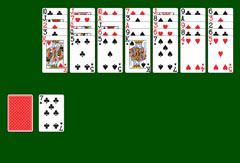
All 52 cards are laid out right at the start, and there is no stock to replenish them. The leftmost column is a single face-up card. The other six hold one to six face-down cards from left to right, each topped by five face-up cards, which makes the rightmost column the longest with eleven cards. The four foundations are stacked one above the other along the left edge. There you build every suit upward from the Ace, and as soon as all four have reached their King, you have won.
- Building: A card finds room only on the card of its own suit that is exactly one rank higher, so the Five of Hearts goes on the Six of Hearts and nowhere else.
- Moving: When you pick up a face-up card, everything above it comes along, sorted or not. Only the card you grab has to fit its destination.
- Face-down cards: As soon as nothing lies on a face-down card anymore, the game flips it without costing you a move.
- Empty columns: On Normal and Hard only a King may enter, happily with its whole load. On Easy any card may fill a gap.
- Foundations: Cards travel there one at a time, always the top card of a column.
- Controls: Tapping a card plays it up if it fits on its foundation, and otherwise moves it with its load to its place in the tableau. Where no such place exists, the card shakes briefly. Dragging with the mouse or your finger works too. Once every card is face up and nothing stands in the way of the rest, the game finishes on its own.
Easy deliberately relaxes one rule, the one for empty columns, and deals friendlier games on top of that. Normal and Hard play by the strict rules, but on Hard more games simply cannot be solved. Undo and Redo work without limits, and the Hint button marks a move that gets you somewhere.
Four ideas that will help you along:
- Play up whatever fits, right away: Once a card may go to its foundation, nothing in the tableau needs it anymore. The only card that could rest on it is the next lower one of the same suit, and that card is already up on the foundation. Playing up is never a mistake here.
- The left column is your first gap: The far left holds just one card. As soon as it moves to its foundation or onto the next higher card of its suit, you have an empty column early on.
- Save gaps for Kings that sit on hidden cards: On Normal and Hard a King can only go into an empty column. If one is stuck in the middle of a column, covering face-down cards, it has earned the first gap you clear.
- Dig on the right: The right-hand columns hide up to six face-down cards stacked on top of each other. Moves that end with a card being turned over there usually bring the most new material into play.
Similar Craft, Different Table: Five Picks from the Collection
Each of the following games shares at least one basic idea with this one, be it the layout, moving whole piles or building in a single suit:
- Yukon Solitaire: The original. Layout and moves are identical, but you build in alternating colors. Every card therefore has two possible bases instead of one, and that is exactly what makes Yukon noticeably more forgiving.
- Australian Solitaire: The nearest relative, where likewise only the same suit builds on itself and whole packets may move. There are no face-down cards there, since all 28 cards in the tableau are face up from the start, but a stock hands out fresh cards one at a time.
- Scorpion Solitaire: Here, too, only a card's own suit counts and whole piles change columns, though face-down cards appear only in the four left-hand columns. Cards do not go home one by one; a suit disappears only once it lies complete in a single column.
- Spider Solitaire: There you may build on any suit, but only runs of a single suit can move together and be cleared at the end. Two decks, ten columns and a stock that keeps adding ten cards make for longer games.
- Simple Simon: A game without a single face-down card, because all 52 are face up across ten columns. Suit does not matter when building, but only runs of one suit move together, and an empty column takes any card.