




Josephine Solitaire – Play Online for Free
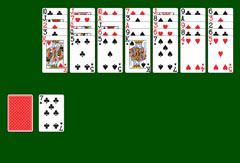
Josephine Solitaire is a two-deck game and the easier-going sister of Forty Thieves. Its layout matches the original, and so do the stock without a second pass and building within the same suit. One single rule makes the difference: here you may move ordered runs of one suit as a whole instead of taking them apart card by card. That turns a notoriously hard game into a far friendlier one, even though plenty of games still refuse to come out.
The name leads straight to the French imperial court. The parent game is also known as Napoleon at St Helena, and in the United States mostly as Forty Thieves or Big Forty. Napoleon is said to have whiled away many hours with solitaire during his final exile on the Atlantic island of St Helena, and a description from as early as 1870 calls this game one of his favorites. The more lenient variant bears the name of his first wife, Joséphine de Beauharnais, who became Empress of the French in 1804. She did not live to see the years on St Helena, having died in 1814. Josephine appears in American solitaire collections by 1939 at the latest, in Helen Leslie Coops' book 100 Games of Solitaire.
Josephine Solitaire Step by Step: Ten Columns, Eight Foundations, Whole Suit Runs
The game uses 104 cards. Ten columns receive four cards each, all of them face up, and the other 64 form a face-down supply in the upper left. Beside it lie the waste pile and eight foundations, two for every suit. Each foundation runs from an Ace at the bottom to a King at the top, and once all eight are complete, you have won.
- Building: A card needs a partner of the same suit that ranks exactly one higher. Since every card is in the game twice, you often get two such spots to choose from.
- Moving suit runs: An unbroken descending run in one suit moves with a single grab, however long it may be. If a card of another suit interrupts the run, only the ordered upper part can be moved.
- Empty columns: Every card and every suit run fits in here; no King is required.
- Stock: Each click lays one card face up on the waste pile, and only the top card there is playable. When the stock runs out, it stays empty, as there is no second round.
- Foundations: Cards go up one at a time, taken from the end of a column or the top of the waste pile.
- Controls: A tap sends a single card to its foundation whenever possible. Otherwise it lands with its run on the matching card, choosing, when there are two, the one where the longer run of its suit already lies, and the game only picks an empty column when nothing else works. You can also drag cards with the mouse or a finger. Once the supply is exhausted and everything left will come out without trouble, the game plays the rest of the hand by itself.
The Easy, Normal and Hard levels differ only in how favorably the cards are dealt. None of them touches the rules, and empty columns take any card on every level.
How to get more out of the two decks:
- Do not fill gaps in a hurry: A free column is the only place where a card with no matching partner can find shelter. Fill it with the first card that comes along and you have given it away before the moment that really counts.
- Long runs are an asset: In Forty Thieves a covered run quickly turns into a wall, whereas here you move it in one piece. So go ahead and build long runs, since they stay mobile.
- Keep both copies in view: Every card exists twice. If one Eight of Spades is stuck deep in a column, the other may already be free, and that is exactly where the Seven of Spades belongs.
- Do not bury the waste pile: Whatever lies there only comes free again from the top down. Play its top card as soon as it fits somewhere, before you click the stock again.
From the Emperor to the Spider: Five Solitaire Games That Pair Well
Four of them need two decks just like Josephine, and two of them also let you move entire suit runs at once:
- Forty Thieves Solitaire: The original that Napoleon is said to have played. Layout, stock and suit rule are the same, but every card moves on its own there. How much that one rule matters, you will feel after just a few moves.
- Spider Solitaire: Two decks, ten columns and runs that only travel together when they share a suit. In Spider, though, suits do not matter when building, and instead of playing cards up one by one, you clear away entire suit runs from the King downward.
- Double Freecell: Likewise 104 cards in ten columns, but all of them face up from the start and without any stock. Eight free cells stand by as a buffer, and building alternates between the colors.
- Harp Solitaire: Klondike with two decks in nine columns, where many cards start face down. The stock can be worked through more than once there, but several cards only move together when a King leads them into a free column.
- Simple Simon: A single deck, everything face up, and just as in Josephine, runs of one suit move as a unit. There is no stock, and cards may be placed without regard to suit.