




Aces Up – Play Online for Free
Aces Up is a fast solitaire game with a simple goal: in the end, the four Aces must be the only cards left. Four piles side by side, a stock that always sends out four cards at once and a single rule for discarding, that is all it takes. The catch lies in the ranking, because unlike in many solitaire games, the Ace is the highest card here, outranking even the King. That is exactly what the name refers to.
The game is older than its plain looks suggest. It was first recorded in England in 1900 by the solitaire writer Mary Whitmore Jones, under the rather unflattering name Drivel Patience. She admitted herself that the name was no compliment, but it was the one people knew the game by. In 1940 it resurfaces as Firing Squad, and names such as Aces High and Idiot's Delight have come down to us as well, but today Aces Up has won the day. A particularly harsh variant lets only Aces into empty piles; here, by contrast, any card may go in.
Four Piles, One Goal: The Rules of Aces Up and How to Win
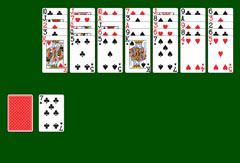
At the start, each of the four piles holds one face-up card, while the remaining 48 wait face down in the stock at the top left. Below it lies the discard pile for everything that leaves the game. You have won when the stock is used up and nothing is left besides the four Aces.
- Ranking: The Ace is the highest card, followed by King, Queen, Jack and so on down to the Two.
- Discarding: When two piles each show a card of the same suit on top, the lower of the two may go to the discard pile. That is why an Ace can never be discarded.
- Empty piles: The top card of any other pile may move into an empty pile, whichever card it is, even one that sits alone on its pile.
- Dealing: Clicking the stock lays out four new cards, one on each pile, empty piles included. You may do this whenever you like, even while moves are still available. There is no second pass through the stock.
- Controls: Tapping a card discards it if that is allowed; otherwise it moves into the first free pile from the left. If you want a different empty pile, drag the card there yourself. Once the stock is exhausted and discarding alone can finish the job, the game clears up by itself.
The level you choose only decides how the cards are distributed. Easy deals hands that forgive small slips, whereas on Hard a handful of moves can already make or break the game.
What experienced players watch for:
- Aces belong in empty piles: An Ace can never be discarded and covers everything beneath it. As soon as a pile frees up, it usually pays to move an Ace there and release the cards it was sitting on.
- Use gaps before you deal: The next click on the stock fills every empty pile. So play out everything a gap makes possible first, and only then fetch new cards.
- Treat high cards as anchors: As long as a King or an Ace lies on top, you can discard any lower card of that suit that shows up. Make the most of such moments before the next deal covers the high card.
- Steer where the new cards fall: Fresh cards land on the four piles from left to right. Where you put a card before dealing therefore decides which new card will cover it.
- Do not discard too quickly: Sometimes it is smarter to move a card into a gap than to discard it at once. The card underneath comes free all the same, and the card you moved stays in play as a potential anchor for its suit.
High Card Wins: Five More Games for Quick Rounds and Sharp Minds
Some of these games are just as brisk, while others share the idea that the higher card of a suit comes out on top:
- Spades: In this trick-taking game with two fixed teams, the higher card of a suit wins just as it does here, and the Ace sits at the very top. Spades are always trump, and before each round you bid how many tricks you plan to take.
- Hearts: Here, too, every trick is decided by the highest card of the suit led, except that you usually do not want to win it. Every heart and the Queen of Spades cost penalty points.
- Calculation Solitaire: Likewise four piles that serve as temporary storage and a stock that goes through only once. Here, though, the cards are sorted onto four foundations in fixed number sequences.
- Golf Solitaire: Another short solitaire for a quick break. Cards move onto a discard pile when they are one rank above or below the top card, and the suit plays no part.
- Accordion Solitaire: If you like simple rules with surprising depth, you will find a long line of face-up cards here that you squeeze together into a single pile. A pile may jump onto the pile right before it or onto the one three places back whenever suit or rank match.