




Alaska Solitaire – Play Online for Free
Alaska Solitaire belongs to the Yukon family and is the more generous sister of Russian Solitaire. As there, you build strictly within a suit, and any face-up card may move with everything lying on it. The difference comes down to a single word: here a card may be placed not only downward but upward as well. That gives every card up to two possible bases where its Russian model offers just one, and many positions that would be hopelessly stuck in Russian Solitaire can still be solved here.
The name fits the picture, too. Klondike, where the whole family began, is a region in Canada's Yukon that became famous for its gold rush at the end of the 19th century, and Alaska is the Yukon's next-door neighbor. Who christened the game is not on record. History still offers a nice footnote: Alaska was part of the Russian Empire until 1867, when the United States bought it. Whether that had anything to do with the choice of name, nobody knows, but it goes well with the game's Russian model. Easy it is not, all the same, since good planning decides almost every game.
Understanding Alaska Solitaire: Two Directions, One Suit, No Stock
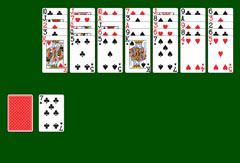
Every card goes onto the table at once, and there is nothing to draw. On the left sits a column with a single face-up card, followed by six columns in which one, two and so on up to six face-down cards hide under five face-up cards each. The four foundations stand one above the other on the left edge and are filled suit by suit from the Ace upward. When all 52 cards are there, the game is won.
- Building in two directions: A card fits on the card of its suit that is one rank higher or one rank lower. The Eight of Clubs may therefore go on the Nine of Clubs and equally on the Seven of Clubs. The count does not go past the King: an Ace never lands on a King, nor a King on an Ace.
- Moving: You may move any face-up card, and everything above it travels along, even a wild jumble. All that matters is the card you pick up.
- Face-down cards: Uncover one and it turns face up on its own.
- Free columns: As long as you play on Normal or Hard, they are reserved for Kings, which may bring everything lying on them. On Easy any card may go in.
- Foundations: You always play off the end of a column, one card after another in rising order.
- Controls: A tap sends a card to its foundation if the foundation will take it. Otherwise the game first tries the card one step higher in that suit, then an empty column, and only as a last resort the card one step lower. If you deliberately want to build upward while another spot is free, simply drag the card there. Once all cards are uncovered and the rest comes out cleanly, the game clears the table by itself.
Easy relaxes the rule for empty columns and deals more favorable cards as well. Normal and Hard keep to the strict rules, with Hard bringing the less favorable deals. Undo and Redo are unlimited, and the Hint button points out the next sensible step.
What works well in this game:
- Downward is the direction that counts: When a card rests on its successor in the same suit, the order is already right for the foundation. Building upward, on the other hand, buries exactly the card the foundation needs next. An upward move is therefore only worth it when it uncovers a face-down card or empties a column.
- The Queen as the King's way out: Unlike in Russian Solitaire, a King does not have to wait for an empty column. It may also go on the Queen of its suit, which is often the quickest way to free the face-down cards beneath it.
- Park cards for a while: You can put a card that is in the way on its lower neighbor for a moment and move it on to the higher one as soon as that comes free. This opens up detours the Russian model does not have.
- Chains beat cosmetics: A face-down card is often just two or three moves away, because first one card has to go to its neighbor and then a second must follow. Short chains like these achieve more than any amount of mere tidying.
Related by Suit, Direction and Map: Five More Tables
Some of these games share the layout, others the building in both directions, and one of them gave the whole family its name:
- Russian Solitaire: The stricter model with the same layout. There a card may only be placed downward, on the card of its suit ranking one above it, and on Normal and Hard anyone who wants to move a King always needs an empty column.
- Yukon Solitaire: The founder of the line, with the same distribution of cards and the same moving of whole packets. You build downward there, alternating red and black, and a card's own suit plays no part.
- Solitaire: The classic whose gold rush country lent the family its name. It comes with a stock, deals far more face-down cards at the start and lets only ordered sequences move together.
- Golf Solitaire: Here you also go one rank up or down, but without regard to suit and always onto a single discard pile. The aim is to clear the seven columns completely, and the stock provides only a limited supply of fresh cards to do it.
- Tri Peaks Solitaire: Three peaks of face-up cards that you clear rank by rank onto the discard pile, whatever their suit. On Easy, King and Ace may even follow each other, which is never allowed in Alaska.